


Icefi: with the current fiscal policy Central America will not be able to meet the Sustainable Development Goals


The Central American Institute for Fiscal Studies (Icefi) expects that the discussions at the XXVI Ibero-American Summit of Heads of State and Government, held in Guatemala, include the challenges faced by the Central American States in order to meet the 2030 Agenda and the United Nations’ Sustainable Development Goals (SDG). Based on technical studies, Icefi warns that, with the current fiscal policy the Central American States will not be able to fully and timely meet the SDG.
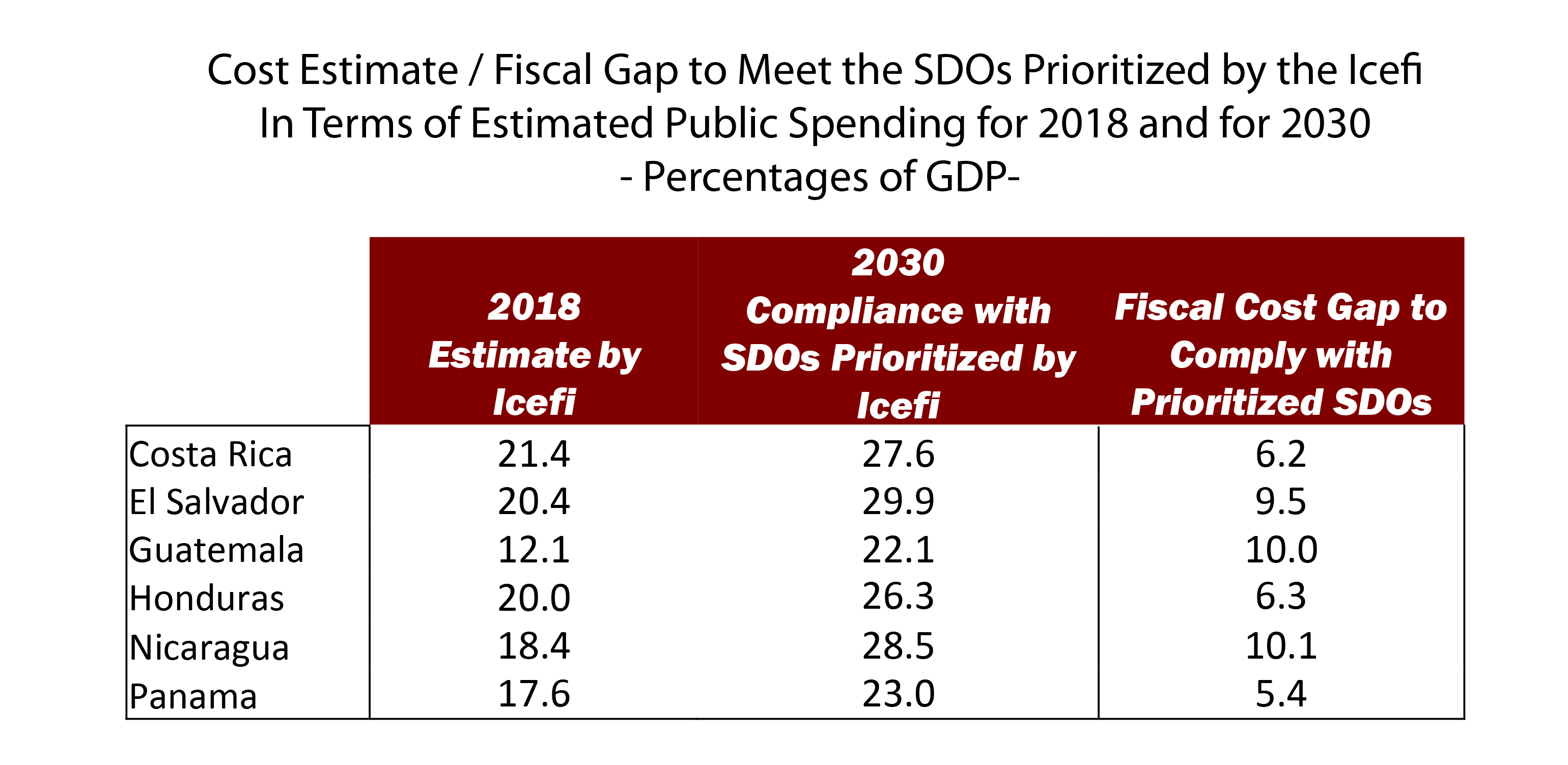
Icefi states that Central America is one of the regions in the world where the philosophical vision that advocates for minimizing the size of the public sector, still persists. On one hand, this vision is reflected in the level of public expenditure; according to Icefi’s calculations, today well below of what is required to meet the SDG. Citing advances of a study that the Institute plans to publish in April 2019, to be able to reach several of the SDG targets that are considered as priority, El Salvador, Guatemala, and Nicaragua must achieve an increase in their public spending in 2030 of around 10% of the gross domestic product (GDP), while Costa Rica and Honduras must increase their public spending by more than 6% of the GDP and Panama by 5.4% of the GDP.
Notes:
- Icefi’s criterion to prioritize SDG’s is to select those whose effect is to support compliance of other SDGs, and those related to eradication of extreme poverty, universalizing education, health, water and sanitation, increasing road infrastructure, providing access to electricity, and changing toward clean types of energy.
- For 2018, Icefi’s estimates for the end of the year based on official data.
- 2030 calculations are preliminary and subject to revision and change.
Icefi believes that the States should consider gradually increase the resources allocated to public social spending, with a priority on the health and education sectors, programs to eradicate extreme poverty, and some public investment in infrastructure like roads, water and sanitation, access to electric energy and transform the energy matrix to adopt generation of clean types of energy.
However, mobilization of domestic resources in Central America to cover these increases in public spending faces very serious technical and political challenges, such as very low and regressive tax revenues, proliferation of unjustified tax privileges and insufficient tools for the tax administrations to become able to fight tax evasion and elusion, especially in the field of illicit flows of capitals. Thus, Icefi warns that the design, approval, and implementation of comprehensive fiscal reforms in the form of a Fiscal Road Map for Central America, with a robust tax policy and administration component, are unavoidable conditions for the region to move closer to a fiscal policy that makes SDG compliance viable.
In Icefi’s opinion, this Fiscal Road Map for Central America should contain:
During the 2020-2022 period: the following measures prior to considering modification of tax rates: remove unjustified tax privileges (increasing tax progressiveness); effective decrease in evasion (increasing productiveness of the income and consumption taxes); review and evaluation of public management and spending; review of the framework for fiscal transparency and anti-corruption policies; and, revision of the civil service.
During the 2023-2026 period: deepening of the process to remove unjustified tax privileges; first increase in the income tax rates in some countries, increase in the value added or sales tax rates; deepening actions against evasion, raising the productivity of the income and consumption taxes; renew the evaluation and planning frameworks; implement effective transparency and probity policies; and implement reforms to civil services.
During the 2027-2030 period: in some countries, a second raise in the income, valued added or sales taxes rates; and a significant increase in the productivity of the income and consumption taxes, linked with institutionalization and permanent enforcement of strict oversight mechanisms against tax evasion.
The Fiscal Road Map for Central America proposed by Icefi also includes recommendations for advancing structural reforms in areas such as modernization of public management, developmental planning, domestic absorption of the new market demand and for planning and executing environmentally-leaning plans. In addition to bringing greater equality, these plans have positive effects on economic growth and job generation, leading to more development and more guarantees for building a democratic Central America.
Icefi is calling on the heads of state and government, other government representatives and delegations, international organizations and other personalities and entities participating in the XXVI Ibero-American Summit of Heads of State and Government to consider the serious fiscal challenges that Central America must overcome to be able to approach compliance with the SDG. The Institute advises that forum that, without fiscal reforms of the magnitude and depth as described, it will be impossible to cover the gaps in public spending (fiscal cost) that afflict Central America and that technically block compliance with the SDG. That is why it hopes that any statements, special communiqués, and other documents containing the agreed commitments and postures, acknowledge these fiscal challenges with a call to the Central American governments to commit to comprehensive tax reforms as quickly as possible.
Central America, November 15th, 2018.
| Adjunto | Tamaño |
|---|---|
 icefi_press_release_ca-03_xxvi_ibero_american_summit_15_nov_2018.pdf icefi_press_release_ca-03_xxvi_ibero_american_summit_15_nov_2018.pdf | 682.96 KB |